top of page

Recent Posts

1/126

Montgomery Twp Health Checkup: The Connection Between Municipal Planning & Residents' Wellbeing

  • 43 minutes ago
  • 6 min read
  • A Rutgers Report Identifies Gaps in Transportation, Access to Fresh Local Veggies, and Physical Fitness (15% of Montgomery Residents Exercise Regularly)


  • Praises Open Space Preservation and Strong Schools

Symbols of Montgomery's Agricultural Tradition, New and Old. From left: Gemini Sisters farm stand in Skillman, The Johnson Family farm stand in Belle Mead, and a farm tractor sign on Route 518 in Skillman.
Photos by Barbara A. Preston

By Barbara A. Preston | May 12, 2026


Montgomery Township, despite its strong agricultural heritage and successful farmland leasing programs, faces "food access gaps." While the township is one of the wealthiest in New Jersey, at least 14% of its working families earn above the Federal Poverty Level (FPL) but not enough to afford basic necessities—housing, food, childcare, transportation, and healthcare—in the high-cost state of New Jersey. Another 3.7% of families live below the poverty line, bringing that to 17.7% of the population that cannot afford, and/or have limited access to local agricultural products [Nutritious veggies, grass-fed beef, locally raised poultry, and more].


Solutions for Montgomery's food access gap would be for township officials to emphasize the construction of "food forests" or community gardens on municipality-owned land. Another is to expand the existing Montgomery Friends Farmers Market program to include a mobile component and more local farmers.


This was one key finding of a comprehensive "health checkup" study presented by Rutgers University Bloustein School of Planning and Public Policy at the township planning board meeting on May 11.


Community gardens exist nearby in Hopewell, Princeton, Raritan, and at Duke Farms in Hillsborough — to name a few. One solution to Montgomery's food gap, according to a study by Rutgers students and a professor, would be to build a few in Montgomery.
Photos by Barbara A. Preston

As part of the Plan4HealthNJ project, Bloustein Professor Thomas G. Dallessio and two graduate students presented findings and suggestions to better integrate public health into municipal land-use. The project, initiated by the American Planning Association New Jersey Chapter with a $1.5 million grant from the Robert Wood Johnson Foundation, selected Montgomery to serve as the study's "suburban" typology, alongside Bethlehem Township (rural typology) in Hunterdon County, and Paterson (urban typology) in Passaic County.


From left: Rutgers Lecturer Thomas G. Dallessio of Hopewell and graduate students Matthew Zarzecki and Jacob Moffatt at Montgomery Township's town hall.
Photo by Barbara A. Preston

Professor Dallessio led a studio semester for eight graduate students at Rutgers Bloustein School, in which they worked with Montgomery Township planners, health officials, staff, and the mayor to explore the relationships between public health and land use, transportation, housing, and conservation.


"When I put together the syllabus ..., I wanted to make sure the students not only beta tested the specific topics within the toolkits, but also to a place-based analysis. I selected Montgomery, partly because I have worked with them before. They've been a phenomenal resource, too. The fact that the township administrator [Lori Savron] is a professional planner, is amazing. And, the township has a full time public health official [Devangi Patel]. It just, it made all the sense in the world. This choice was easy. And when we called, Lori said, 'yes,' immediately."


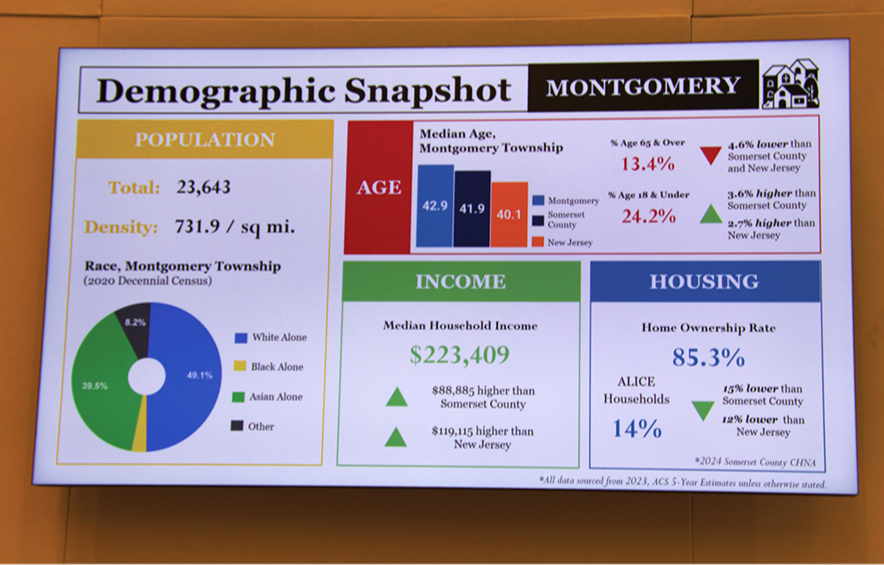
Montgomery Demographics: An ALICE household refers to residents who are Asset Limited, Income Constrained, and Employed. These are working families earning above the Federal Poverty Level (FPL) but not enough to afford basic necessities—housing, food, childcare, transportation, and healthcare—in the high-cost state of New Jersey. The median income in Montgomery is $223,409 — that's $119,115 higher than the average NJ household income.
Graphic from Rutgers University.

Demographics

Master's degree candidate Jacob Moffatt, one of two presentators, said Montgomery is known for its farmland aesthetic and excellent public schools. The population of 23,643 people is on the small side for a suburban community. It also has a population in which 42% of the residents age 5 and older speaks a language other than English at home.


"Montgomery also is much wealthier than its peers, with a median household income more than double that of the rest of the state, and the housing stock is much newer that the rest of the county," Moffatt said. "ALICE (Asset Limited, Income Constrained, Employed) households are low, at just 14%, compared to the state average [39% according to UFA] ."


The average life expectancy is over 80 years, and residents generally have lower incidences of chronic diseases and other poor health outcomes, he said.


Advertisement


Key Findings

The student research team used six Plan4HealthNJ toolkits to analyze Montgomery's current health status, identifying strengths, challenges, and opportunities for improvement:


  • Mobility / A Transit Desert: Montgomery was described as a "transit desert" for those without cars. Senior citizens often struggle to reach healthcare destinations, and shopping. Also, automobiles are the number one cause of air pollution in the state. The study recommended exploring micro-transit partnerships, similar to programs in Jersey City and Middlesex County.


  • Environmental Sustainability: The township has made significant progress in protecting open space but faces challenges regulating dispersed nuisances like highway noise, air pollution from leaf blowers, and light pollution (the lack of a "dark sky").


    • Regarding noise and air pollution caused by landscapers. It lauded Montgomery for having restrictions on gas-powered leaf blowers.


    • (Leaf blowers and heavy-duty, gas-powered lawn mowers pose significant health risks, primarily due to toxic, high-emission two-stroke engines, dangerous noise levels, and the suspension of particulate matter. Key risks include respiratory issues (asthma), cardiovascular diseases, permanent hearing loss, and exposure to carcinogens like benzene. One hour of one gas leaf blower use can emit as much pollution as driving a car for over 1,000 miles, according to the Mount Sinai Icahn School of Medicine.)


Advertisement


Key Findings

  • Housing & Community Development: While the township excels in environmentally sustainable housing practices and building coverage calculations, challenges remain in diversifying housing types. The report suggested increasing permissions for non-single-family housing and assisted living facilities.


  • Healthcare Access: While permissions for medical facilities exist in some zones, they are not permitted in the majority of the town. Expanding use permissions for medical offices could improve overall accessibility.


  • Policy & Civic Engagement: The study urged a re-approach to civic engagement that prioritizes transparency and accessibility, including providing translated versions of master plans for the 42% of residents who speak a language other than English at home.


  • Healthy Food Access & Agriculture: Despite its strong agricultural heritage and successful farmland leasing programs, Montgomery faces "food access gaps." Residents on the western side of the township and those without vehicles find it difficult to reach grocery stores, the food pantry, or the farmers' market.


Montgomery officials could make it easier for all residents to grow their own fresh food, and to better access locally grown/produced food and agriculture, according to Rutgers student presentation.

Community gardens, which Montgomery officials have identified as a priority in municipal strategy, could be sited on municipal land. Another opportunity is the creation of food forests, a form of low- maintenance, resilient permaculture that allows for sustainable use of open space — especially in comparison to underutilized and environmentally destructive lawn space.


Overall, public health data show that Montgomery is below the state and county averages for several conditions, including asthma, heart disease, obesity, and stroke.


Local Hazards: The Radon Risk

One notable health hazard identified was radon exposure. Due to underlying geology, a 2022 report showed that 41% of homes tested in Somerset County had radon levels exceeding four picocuries per liter, compared to just 12% statewide. Radon is the second leading cause of lung cancer after smoking, and the report emphasized that there is no safe level of exposure.


Radon Kits Available

Montgomery Health Department offers free test kits so that you can measure levels and determine if remediation is needed. Kits are available in person, on a first-come basis, at the Montgomery Health Department, 2nd Floor of Municipal Center, Monday to Friday, 8 am to 4:30 pm The best time of year to test is when windows are closed.


The walkability score of Montgomery was just 9 out of 100. Adults reporting physical activity in the last 30 days was just 14.9%.

An opportunity for increasing walkability and exercise in general includes adding more sidewalks and bicycle lanes to a pedestrian masterplan to emphasize safety. This also addresses mobility needs for youth and those without a car — a key to reducing social isolation and fostering independence.


Civic Engagement

Master's degree candidate Matthew D. Zarzecki, one of two presentators, said that civic engagement is immensely importation when if comes to land-use planning.


"We recommend prioritizing and informing community members of planning processes," Zarzecki said.


Planning requires deep, contextual connections to the community and local knowledge grounded in that community.

— Alejandra Cordier, Jacob Moffatt, and Matthew D. Zarzecki


The Path Forward: Implementation Framework

The students outlined a seven-step implementation framework for the township to adopt over the coming year:

  1. Foster collaboration between the planning and the public health department.

  2. Widen the stakeholder team to include community-based organizations and residents with disabilities.

  3. Collect and analyze data using the Plan4HealthNJ mapping tool.

  4. Consolidate findings into an engaging public report to receive resident feedback.

  5. Draft land-use recommendations, such as permitting mobile food pantry sites and food forests on municipal land.

  6. Formally adopt recommendations with effective, time-bound metrics.

  7. Move toward a "Health in All Policies" approach for all future decision-making.


Mayor Neena Singh and the Township Committee expressed gratitude for the study, noting that Montgomery has received a $50,000 grant to continue these efforts. The mayor has noted that Montgomery Township has received a Healthy Town designation for the second year in a row. The diverse programs offered to residents ensure that the health and wellness needs of the entire community are being met.


Professor Dallessio concluded the presentation, saying, "If we don't have health, we don't have anything,"


bottom of page