top of page

Princeton University Art Museum, One of the World's Greatest Places to Visit, Is Right in Our Own Backyard

  • 1 day ago
  • 7 min read

Words by Barbara A. Preston for The Montgomery News | August 20, 2026

Most Photos by Maria Kauzmann and Barbara A. Preston


A tremendous treasure trove of art, with rare objects dating back to 3,500 BCE, is located right in our backyard. TIME magazine named it one of the World’s Greatest Places to visit in 2026 — yet how many locals have taken the time to make the trip?


Main entrance to the Princeton University Art Museum.

Summer is the perfect time to go to the Princeton University Art Museum. The campus — which is a work of art itself — is lush with trees, gardens, and flowing fountains. It is a brisk 15-minute walk to the museum from most parking areas, which gives visitors a chance to admire Collegiate Gothic buildings, modern outdoor sculptures, and grotesque gargoyles.


The Montgomery News tapped two Rocky Hill residents who have offices inside the museum and asked each for short guided tours of their favorite exhibits in the newly constructed 146,000-square-foot facility, which opened to the public on October 31. (The museum’s history dates back to its original founding in 1755, the previous building was closed and razed to make way for this modern building.)


Our guides will be Chris Newth, senior director for collections and exhibitions, and Pamela A. Patton, director of the Index of Medieval Art.


Chris Newth of Rocky Hill is senior director for collections and Exhibitions at the Princeton Art Museum. Pamela A. Patton of Rocky Hill is director of the Index of Medieval Art in Princeton University’s Department of Art & Archaeology.


Chris Newth

Newth lives in the 300-year-old Murphy Voorhees house, circa 1731, in Rocky Hill. He has about a 10-minute drive to his work at the museum. The house is worth mentioning because both Newth’s home and his place of employment are national treasures. Previous homeowner Abraham O. Voorhees is said to have hosted George Washington in 1783 while he waited to hear news about the Treaty of Paris.


As senior associate director for collections and exhibitions, he gets to share his appreciation of art and history, working with teams to determine what to put in the museum’s 30-some galleries.


Advertisement

Martin Wealth Management

Newth’s Museum Tour

Juxtapositions

During a July tour of the museum, Newth said he encourages visitors to follow their own intuition rather than following curated dictates.


Newth stopped in an area by the orientation gallery. Walk straight, and a visitor will see a huge portrait titled George Washington at the Battle of Princeton, 1783-84 by Charles Willson Peale.


In the same line of sight, a visitor will see Guanyin, the Chinese Buddhist deity, in “royal-ease” pose, ca. 1250.


On left: Guanyin, the Chinese Buddhist deity, in “royal-ease” pose, ca. 1250. The name means “The one who perceives the sounds of the world.” Guanyin is somebody who achieved enlightenment, but who actually decided to stay on Earth to help others try to achieve it.

On right: George Washington at the Battle of Princeton, 1783-84 by Charles Willson Peale (1741– 1827; born Chester, MD; died Philadelphia, PA), Oil on canvas. Princeton University, commissioned by the trustees.


“Guanyin and George Washington are two individuals who are recognized in various cultures for very different reasons,” Newth said. “Both objects are controlling our gaze. This is a powerful moment.


“It highlights our goal, which is to allow people to go with what they see as opposed to being told how to look and where to look. You get to decide what you want to see and how you see it.”


Left: Giovanni di Tano Fei, Virgin and Child, detail, 1384-1405. Princeton University Art Museum.
Right: Andy Warhol, Blue Marilyn, 1962. Princeton University Art Museum.

Another example is the pairing of a medieval reclining knight next to a 20th-century work by the artist Christian Boltanski. The pairing spans 500 years, yet they speak to each other across time through the lens of permanence and memory.


On left: Spanish, Artist unidentified, Gisant: knight in armor, ca. 1500. Alabaster; 63.5 × 189.9 × 43.3 cm.
On right: Christian Boltanski, Autel de Lycée Chases (Altar to the Chases High School), 1987–88. Princeton University Art Museum.
© 1988, Christian Boltanski

This curatorial strategy—placing objects in dialogue rather than in isolation—runs throughout the museum. Whether it is an exploration of ancient ball games from Central and South America or a “works on paper” installation addressing the question, “What is an American?” in time for the nation’s 250th anniversary, the museum is actively creating “powerful moments” of discovery.


“Every time I come, I notice something different,” Newth says. “I also fundamentally believe art—and I look at art as a kind of history—should be available to people. We offer free admissions to all our exhibitions and galleries, which is wonderful.”


The “orientation gallery” and lower level of the museum is open from 8 am until 10:45 pm, seven days a week.


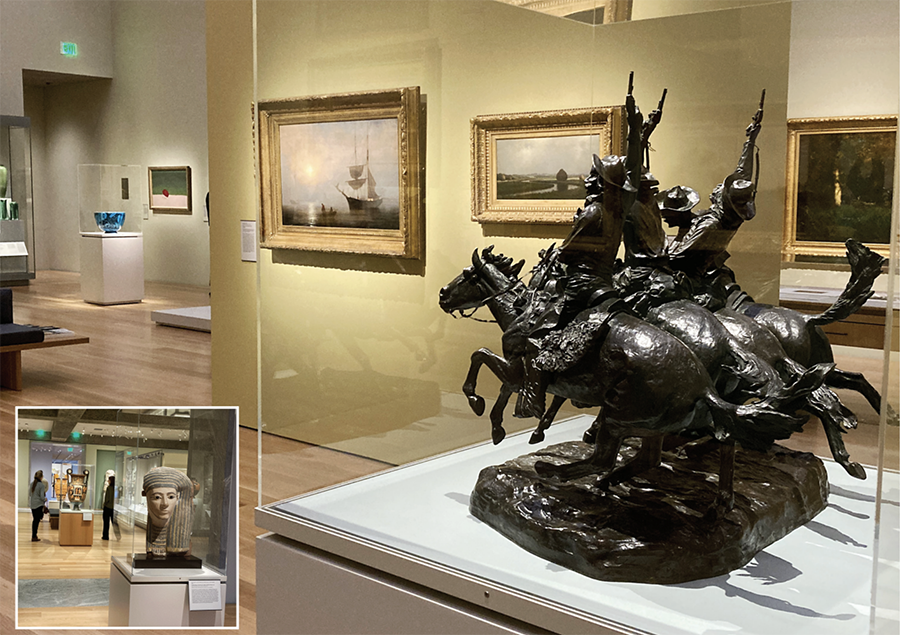
Objects in the American Art Gallery at the Princeton University Art Museum.

Pamela A. Patton

Finding Meaning in the Wander: A Journey Through Art History

A sensation familiar to many museum-goers is the mild disorientation of turning a corner, expecting a chronological march through history, and finding oneself instead in a space that defies easy categorization.


At the Princeton University Art Museum, this “discovery-oriented” layout—where objects from vastly different eras and cultures are juxtaposed—is a deliberate choice, one that is as challenging as it is illuminating.


“I’ve gotten lost in here more times than I can count,” says Patton, who spent 23 years teaching at Southern Methodist University in Texas before moving to Princeton.


Xochipala, Early Formative Period, ca. 1500 BCE, Guerrero, Central Mexico, Female figure with elaborate hairstyle, arms outstretched. Princeton University Art Museum.

The art museum is “very discovery-oriented. You walk in and you are faced with all these possible ways to go, and not a lot of signage,” Patton says.


Yet, it serves as a prompt for inquiry.


Patton’s path to directing one of the field’s most vital research units was, in itself, a process of discovery. Decades ago, Patton began as a student with aspirations of being a painter. “I was an artist— an artist with limits,” she told The Montgomery News.


“As a teenager, I was very good at the hyper-realistic drawings. Technically, I was good, but I wasn’t a creative.”


Discouraged by avant-garde professors who pushed for a different vision, she found refuge in art history.


“I realized I could be satisfied by studying and writing about the artists who I thought were good, instead of trying to imitate them,” she said. It was a pivot from the easel to the archive, leading her to Williams College, Boston University, and eventually to the helm of Princeton’s Index of Medieval Art.


Preclassic era ball players

Patton’s Museum Tour

Patton’s approach to art is as much about critique as it is about appreciation. Stopping before a portrait once titled “Gypsy with a Cigarette”—a name she finds problematic—she notes the museum’s efforts to re-title and contextualize such works.


Woman with a Cigarette, ca. 1878–80. Oil on canvas. Édouard Manet, 1832–1883; born and died Paris, France.

“I think they wanted to kind of connect European tradition with the rest of the world and acknowledge the colonialism that was part of it,” she says.


She points to another example: lusterware, a style of pottery decorated with metallic oxided glazes, was developed in the Middle East by Muslims in the ninth century to imitate the porcelains produced in China. The technique then traveled from the Arab world to Spain, eventually being adopted by Christian artists. It is, she notes, a perfect example of how artistic ideas are mobile, moving across borders and cultures, often in imitation of one another.


Advertisement

Princeton Symphony

In a world where we often seek the comfort of neatly labeled categories, Patton finds beauty in the blurred lines. Whether it is navigating the museum’s winding, halls or parsing the complex, cross-cultural history of a ceramic bowl, the lesson remains the same: the act of “wandering” is, in itself, a form of discovery.


Marble sculpture titled Nydia, the Blind Flower Girl of Pompeii, after original model of 1855 by Randolph Rogers. The sculpture is based on Sir Edward Bulwer-Lytton’s best selling novel The Last Days of Pompeii (1834), and depicts Nydia, a blind girl who makes her way through the debris-strewn city during the eruption of Mount Vesuvius.


The Digital Index of Medieval Art

The Index of Medieval Art is a specialized research unit—a vast, database of iconography where scholars can track the evolution of images, from the depiction of the Virgin Mary in 13th-century France to Coptic Egypt.


“We’re a resource for people who want to research the history of the image in the Middle Ages, how images worked, how people represented things,” Patton explains. While the project is academic, it is also deeply human.


A search through the database might yield somber religious iconography or, unexpectedly, “cats playing musical instruments.” Visit the archive online at: theindex.princeton.edu.


Pamela Patton’s books include: “Art, Power, and Resistance in the Middle Ages,” and “Art of Estrangement: Redefining Jews in Reconquest Spain.”

Pamela Patton’s book, “Art of Estrangement: Redefining Jews in Reconquest Spain,” is available from Penn State University Press.


Parking

There is no public parking directly at the Princeton University Art Museum. Visitors may park for free at the Stadium Drive Garage at 148 Fitzrandolph Rd, which is about a 20-minute walk. Or, try your luck at metered parking on Nassau Street, Williams Street, or Prospect Avenue. The downtown Spring Street Municipal Garage (24 Spring Street), also is available for a fee and is a 10-minute walk from the museum.


Left: George Segal, The Dancers, 1971. Princeton University Art Museum. ©The George & Helen Segal Foundation / Licensed by VAGA at Artists Rights Society (ARS), New York Right: Nick Cave, Let me kindly introduce myself. They call me MC Prince Brighton., 2025. Princeton University Art Museum. © Nick Cave.

ADA drop-off and parking at the museum requires approval to drive onto campus. Please contact the museum at least 3 business days in advance to request campus access. Call 609.258.3788 and select option 1 to speak to a visitor services staff member, or email Louise Barrett at lkiefer@princeton.edu.


A map of the museum is available at artmuseum.princeton.edu/visit/museum-map.


Learn more at artmuseum.princeton.edu.


Current exhibitions at Princeton University Art Museum

bottom of page